In our seminar rooms or comfortably from home!
Our bestseller workshops

 PDF
PDF


Seminartermine nach Kategorien
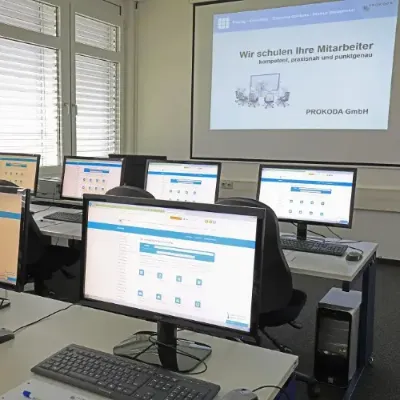
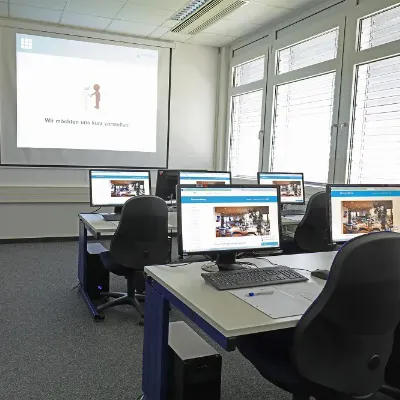
You can rent our seminar rooms!
Your booking with us is transparent and flexible, without hidden costs. Our seminar rooms in Cologne not only offer pleasant air conditioning, but are also equipped with high-quality technology such as PCs, flat screens and projectors.

Microsoft 365 – Basics & Overview
1-Day Workshop
The introduction of Microsoft 365 presents employees with the challenge of becoming familiar with new features. At the same time, personal workflows and team processes are changing and must be restructured and optimized.
This training focuses on the possibilities of cloud-based collaboration, the use of cloud storage, and the online and desktop versions of the familiar applications Word, Excel, PowerPoint, and Outlook. You will learn how to store files in the cloud, co-author documents, and share them with others. In addition to understanding general updates, you’ll also discover new features in each individual application.
Workshop Content
Microsoft 365 Overview
- Differences and uses of the online versions
- Editing files in Teams, browsers, and the desktop app
Saving & Working in the Cloud
- Basics of cloud storage with SharePoint and OneDrive
- Accessing cloud storage
- Co-authoring documents
- Sharing files
- Viewing version history
New Apps in M365 – An Overview
- Team task planning with Planner
- Personal task management with To Do
- Creating surveys with Forms
- Real-time communication with Loops
- Collecting and visualizing data with Lists
New Features in Word, PowerPoint & Outlook
- Introduction to the new start page
- New: Dictation and translation features
- New: Icons
- Accessibility check and application settings
- PowerPoint: Optimizing presentations and launching them in Teams
New in Excel
- Sheet views
- Navigation pane
- Show changes
- Dynamic array functions
Who Should Attend This Workshop?
Decision-makers, project managers, and users who want to learn about the new features in Microsoft 365 and how to use them effectively.
Microsoft Copilot for Developers
2-Day Workshop
Copilot is an intelligent real-time assistant that boosts creativity and productivity by seamlessly integrating into your workflows. This technology can be customized to individual needs—it automates tasks, optimizes processes, and enhances team collaboration.
In this hands-on workshop tailored specifically for developers, you'll learn how to effectively integrate Copilot into your development processes to enhance the functionality of your applications.
Workshop Content
Basic Use of Copilot
- Generating code suggestions
- Autocompletion
- Error detection
Advanced Features of Copilot
- Context-aware code suggestions
- Code optimization
Excel Programming with Copilot
- Creating UserForms
- Generating program code for filtering and analyzing data
Automated Data Analysis in Power BI
- Using Copilot to automatically generate DAX expressions
- Writing queries in Power BI reports
Workflow Creation in Power Automate
- Using Copilot to generate workflow scripts
Customizing Copilot Suggestions to Specific Requirements
- Techniques to tailor Copilot-generated code to meet individual needs
- Tips & tricks
Who Should Attend?
This training is aimed at software developers and programmers who want to expand their knowledge and skills in working with Copilot.
Microsoft Copilot for Office 365
2-Day Workshop
With this intelligent real-time assistant, you can boost creativity and productivity, as Copilot integrates seamlessly into your workflows.
Copilot can be customized to individual needs and supports executives, IT professionals, and everyday Office users alike. It automates tasks, optimizes workflows, and enhances collaboration within your team.
Copilot isn’t just helpful for web searches in Bing or programming—it has been available since early 2024 to support users directly in popular Office applications like Word, Excel, PowerPoint, Outlook, Teams, and OneNote.
With a single click in any of these applications, you can launch Copilot.
Every day brings a range of tasks, and Copilot provides real-time support to help you complete your work more efficiently and easily.
Workshop Content
General Foundations of Artificial Intelligence & Working with Copilot
- What are prompts?
- How to formulate prompts / perform intelligent searches
Copilot for Word
- Generate texts based on individual requirements
- Compare documents according to specified criteria
- Summarize content & list key points
Copilot for Excel
- Analyze spreadsheets & calculate results
- Create charts to highlight and present key data
- Use conditional formatting to highlight important data
Copilot for PowerPoint
- Automatically create presentations based on your specifications
- Generate summaries from one or multiple presentations
- Adjust slide masters to match your corporate design
Copilot for Teams
- Generate summaries of chats & meetings
- Extract pro & con evaluations from discussions
- Analyze meeting participation and speaking time in online or live meetings
Copilot for Outlook
- Draft & reply to emails based on your preferences
- Summarize all emails in a conversation thread
- Get coaching to write clearer, more focused emails
Copilot for OneNote
- Create a structured task list for you and your team from your notes
- Generate detailed, structured texts based on your notes
- Provide a summary of an entire section
Who Should Attend?
All users who want to optimize and simplify their daily tasks using Microsoft Office applications.
Microsoft AI Builder
What is AI Builder?
Microsoft’s AI Builder is a powerful tool within the Power Platform that allows you to integrate artificial intelligence (AI) into your business processes and applications—even without deep programming knowledge. Use predefined AI models or create your own to automate tasks such as form processing or text analysis. AI Builder can also create prediction models based on historical data—for example, to forecast sales figures or analyze customer feedback.
Difference Between Copilot and AI Builder
Copilot provides direct support in Office applications like Word and Excel by suggesting text, analyzing data, and simplifying complex tasks. AI Builder, on the other hand, enables the creation of customized AI models to automate specific business processes such as invoice processing or forecasting.
|
Application Area |
Functionality |
Target Audience |
Example |
|
Microsoft Copilot is integrated into Word, Excel, PowerPoint, and other Office apps |
Uses advanced AI models like ChatGPT to assist users in creating, editing, and analyzing content |
Wide range of users, from individuals to enterprises |
Assistance with creating complex formulas in Excel or analyzing data |
|
AI Builder is part of Microsoft Power Platform (Power Apps, Power BI, Power Automate, and Power Pages) |
Enables the creation and integration of predefined or custom AI models |
Business users and developers |
Creating a model to automatically analyze invoices |
Target Audiences of AI Builder
Microsoft AI Builder is aimed at a wide range of users across different fields:
- Business Users: Individuals without deep technical knowledge who want to integrate AI-powered features into their business processes. AI Builder allows you to create AI models without coding and integrate them into Power Apps, Power Automate, and Power BI.
- Developers: Programmers looking to integrate AI models into their applications. AI Builder offers predefined models that are easy to configure and customize.
- Data Analysts: Professionals who work with data and want to build complex models or optimize existing ones. AI Builder offers a user-friendly platform to test and deploy models across the organization.
- Companies of All Sizes: Especially small and medium-sized businesses that may not have extensive IT resources can benefit from AI Builder by integrating AI technologies to enhance efficiency.
Where Can AI Builder Be Used?
- Power Apps
- Power Automate
- Power BI
- Dynamics 365
- Microsoft Dataverse
AI Builder in Power BI
- Data Analysis and Predictions: AI Builder models can be embedded into Power BI reports to perform predictions, classifications, or other AI-driven analytics. These functions can be integrated directly into Power BI reports.
- Automated Analytics: Integration with Power Automate allows the creation of automated workflows that utilize AI Builder models. For example, data loaded into Power BI could be automatically analyzed by an AI Builder model before visualization.
- Visual Adjustments and Insights: Power BI allows you to embed AI models directly in reports—for instance, for text analysis or image recognition applied to existing report data.
- Use of Predefined Models: Power BI includes predefined AI visualizations, enabling features like sentiment analysis, object recognition, and more. These often rely on the same AI technologies used by AI Builder.
AI Builder and Excel
While Microsoft AI Builder cannot be used directly within Excel, there are various ways to integrate the two:
- Integration via Power Automate: AI Builder is integrated into Power Automate, allowing you to create automated workflows. For example, you could analyze or process Excel data using AI models—such as auto-categorizing data, extracting information from text, or predicting trends.
- Data Import and Export: You can import data from Excel into Power Apps or Power Automate and apply AI models there. The results can then be exported back to Excel.
- Advanced Analysis in Power BI: If using Power BI, you can integrate AI Builder models into your analysis. Results can then be incorporated into Excel-based reports.
- Custom Connectors: In Power Apps and Power Automate, you can create custom connectors, enabling the use of AI Builder models to directly process and transfer data to and from Excel files.
AI Builder in Power Apps
AI Builder in Power Apps allows you to integrate AI-powered features into your custom apps. Key functionalities include:
- Image Recognition
- Create models to detect and classify objects in images. For example, build an app that identifies product damage or inventory items by simply taking a photo.
- Form Processing
- Automatically extract data from structured documents like invoices, order forms, or receipts. This data is then added to your app without manual input.
- Text Classification
- Analyze text data efficiently and automatically categorize it. For instance, an app could classify customer feedback as positive, negative, or neutral.
- Sentiment Analysis
- Analyze the sentiment of text. This can be used in apps to evaluate customer feedback or social media comments to understand overall sentiment.
- Prediction Models
- Create models based on historical data to predict future events—such as what products a customer might buy or estimating future resource needs.
- Object Detection
- Detect specific objects in images, useful in inventory management or quality assurance apps.
- Handwriting Recognition
- Convert handwritten notes into digital text, which can then be stored or processed within your app—for instance, digitizing meeting notes.
- Custom Business Models
- Create custom models tailored to your business needs and integrate them into Power Apps to automate specific tasks or processes.
AI Builder in Power Automate
AI Builder in Power Automate enables the development of various AI-driven automations to streamline your workflows. Key features include:
- Automated Document Processing
- Form Processing: Automatically extract data from forms, invoices, receipts, and other documents, then transfer the data into systems or databases. For example, incoming invoices can be read and key information sent to an accounting system.
- Image Processing
- Object Recognition: Create workflows that analyze uploaded images and perform actions based on the recognized objects—such as sorting or forwarding images.
- Text Analysis
- Text Classification: Automatically analyze and categorize texts. For example, emails could be analyzed and routed to the appropriate department based on their content.
- Making Predictions
- Prediction Models: Develop workflows that make predictions based on historical data. For instance, send alerts when a sales forecast exceeds or falls below certain thresholds.
- Automated Business Decisions
- Custom Models: Create custom models that automate specific business decisions—e.g., approving or rejecting customer requests based on past outcomes.
- Handwriting Recognition
- Convert handwritten forms or notes into digital text and send that text to recipients or databases via workflow.
- Process Automation
- Automate recurring tasks like data processing or report generation. AI Builder performs these tasks based on intelligent analysis and decision-making—efficiently and accurately.
Data Centre training for many companies:
These customers already trust us
Maximize the security and efficiency of your data center with our certified Data Centre Training. Our practical training courses provide essential know-how on the design, operation and compliance of data centers. Through continuous training, you reduce downtime, minimize sources of error and meet international standards. Benefit from recognised certifications with the globally accredited training courses from PROKODA GmbH & EPI.