In our seminar rooms or comfortably from home!
Our bestseller workshops

 PDF
PDF


Seminartermine nach Kategorien
You can rent our seminar rooms!
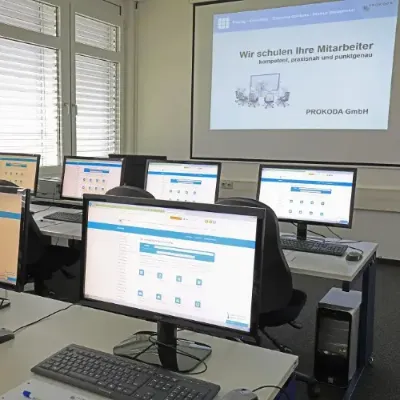
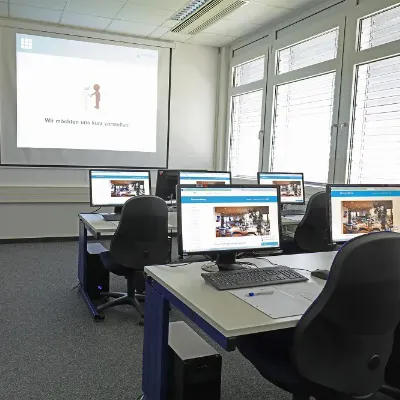
Your booking with us is transparent and flexible, without hidden costs. Our seminar rooms in Cologne not only offer pleasant air conditioning, but are also equipped with high-quality technology such as PCs, flat screens and projectors.

Your central qualification for AI compliance, governance, and safe AI deployment under the EU AI Act
The EU AI Act has been in force since August 1, 2024. By August 2026, organizations must have implemented all key obligations. These include building an effective organizational framework, establishing documented processes, implementing risk management, and ensuring verifiable training and qualification for all employees working with AI systems. AI compliance has therefore becomes a strategic leadership responsibility: Only organizations that establish structures early gain legal certainty, minimize risks, and leverage AI productively and responsibly.
The EXIN AICP certification qualifies professionals and leaders to assess AI systems in accordance with the law, evaluate risks accurately, and establish responsible AI governance across the entire organization fully aligned with the EU AI Act and international standards.
Why the AICP is essential now
1. Meeting EU AI Act requirements with confidence (Articles 4, 8, 9, 10)
The EU AI Act demands more from organizations than technical adjustments.
It requires structured AI management, clear responsibilities, documentation, risk analyses, and mandatory qualification.
The AICP provides exactly this knowledge: practice‑oriented and exam‑focused.
2. AI affects every business area — HR, leadership, compliance, IT
AI is used in recruitment, HR processes, communication, production, service, and management.
The AICP creates a shared understanding of how to classify AI systems, identify risks, and determine an organization’s role as provider, deployer, or integrator.
3. Future‑proofing through clear AI structures instead of isolated solutions
To use AI safely, organizations need:
- an AI inventory
- clear roles and responsibilities
- transparent decision‑making processes
- documented risk and data‑quality assessments
- an AI management system based on ISO/IEC 42001
The AICP shows step‑by‑step how to build and implement all these elements effectively.
4. Practical tools, templates & immediately applicable methods
You receive ready‑to‑use resources:
- risk‑analysis templates
- data‑quality checklists
- role models & process guidelines
- templates for AI documentation and classification
- best practices from organizations and public authorities
What you will learn in the AICP training
Understanding the EU AI Act
- Scope, classification & risk levels
- Prohibited practices, obligations & oversight mechanisms
- Article 8 (data), Article 9 (risk management), Article 10 (documentation)
AI Compliance & Governance
- Building an AI management system according to ISO/IEC 42001
- AI risk management based on ISO 23894
- NIST AI RMF & EU ethics guidelines
- Documentation requirements & audit preparation
Responsible & transparent AI
- Fairness, bias mitigation, explainability
- Data protection & GDPR compliance
- Oversight, monitoring & human supervision
Practical implementation for organizations
- End‑to‑end governance across the full AI lifecycle
- Assessing AI systems (High‑Risk, GPAI, Low‑Risk)
- Role models for providers, deployers, integrators
- Tools & processes for AI project teams and HR
Your benefits with the AICP certification
- Legal certainty when deploying AI
- Reduction of liability and reputational risks
- A structured roadmap to EU AI Act compliance
- Qualified employees & clear responsibilities
- Internationally recognized EXIN certification
- Immediately applicable results through practical tools
Who should attend the AICP program?
- HR professionals & leaders
- Compliance and risk management
- Data protection officers
- IT management & AI project leads
- Product management
- Professionals and leaders across all industries
Why PROKODA?
- EXIN‑accredited training provider
- Practice‑oriented methodology & real case studies
- Proven methods, templates & governance blueprints
- Classroom, online, hybrid & in‑house formats
Start now and book the AICP certification
Contact: info (at) prokoda (dot) de
Dates & program information: AICP Training
EU AI Act – The Law on Artificial Intelligence
Recognize. Understand. Implement.
The EU has introduced the AI Act – a comprehensive law for artificial intelligence. Its goal is to combine innovation with safety by setting clear obligations, risk-based classifications, and harmonized rules for AI use across Europe.
The focus is not only on technology, but also on trust, responsibility, and transparency. Companies developing or using AI systems now need to act.
What does the AI Act regulate?
The AI Act defines four levels of risk:
- Prohibited AI – e.g., real-time biometric surveillance in public spaces or social scoring (except in very limited cases)
- High-risk AI – in areas like HR, education, healthcare, justice, or critical infrastructure
- Limited risk – e.g., chatbots or AI systems that must be clearly identified as such
- Minimal risk – like AI in spam filters or games, with no specific obligations
The higher the risk, the more extensive the requirements – especially for companies that develop, operate, or use high-risk AI systems.
Who is affected?
The AI Act applies to:
- AI system providers (e.g., manufacturers, developers)
- Operators, meaning companies using AI commercially
- Importers and distributors of AI systems
- Non-EU companies, if their AI is used within the EU
The regulation thus has a global reach – becoming a de facto international standard.
Training obligation under Article 29 – and training recommendations
A key provision for providers of high-risk AI systems: Employees working with such systems must be appropriately qualified.
This requirement stems from Article 29(4) of the EU AI Act.
Providers must ensure that affected persons have sufficient knowledge, training, and experience – regardless of whether they work in development, application, or operations.
This includes roles such as:
- Data scientists, developers, MLOps
- Business departments using AI in processes (e.g., HR)
- IT administrators responsible for operations
- Project managers overseeing implementation
In addition to this mandatory training, a recommended training is advised for companies and employees applying AI or integrating it into business processes. It helps them understand the regulation and develop skills for responsible and informed use of AI.
Our Training Offer
We provide practical support: Our training is designed for anyone preparing for the responsible use of AI in their workplace.
Participants receive:
- Legal foundations
- Ethical guidance
- Organizational knowledge
to use AI applications responsibly, sustainably, and in compliance.
This training provides essential orientation knowledge but does not replace the mandatory training for providers of high-risk AI systems.
From Excel Expertise to Confident Copilot Usage in Everyday Work
2-Day Training
“I know Excel – but how exactly does Copilot help me?”
“I want to understand what Copilot suggests – not just click through it.”
“How can I produce results faster and with more structure?”
This course is designed for professionals who are already confident using Excel – and now want to learn how to use Microsoft 365 Copilot strategically to work with data more effectively, efficiently, and independently.
Participants will analyze, structure, and interpret tasks first using Excel – and then with Copilot.
Not redundantly – but intelligently. Not blindly – but with intention.
Core Message:
You won’t just learn what Copilot can do – but how to integrate it meaningfully into your Excel workflows.
You’ll learn:
- how to turn complex questions into clear prompts,
- how to understand, refine, and improve Copilot’s responses,
- and how to stay in control and make informed decisions yourself.
Understand, don’t guess. Structure instead of gut feeling. Copilot as a colleague – not a machine.
Inhalte
Day 1 – Mastering Excel, Using Copilot Effectively
Goal: Confident Excel use & evaluating Copilot’s results with competence
|
Topic |
Without Copilot |
What Copilot Adds |
|
Introduction to Copilot |
Interface, requirements, access |
Prompt basics & usage logic |
|
Tables & Structure |
Create, structure, and filter tables |
Suggestions for cleanup & transformation |
|
Functions & Logic |
Use of IF, XLOOKUP, AVERAGE, etc. |
Generate and explain formulas |
|
Data Cleaning |
Manual error correction & format checks |
Automated cleaning suggestions |
|
Visualization |
Create charts & pivot tables manually |
Copilot-driven analysis & visualizations |
|
Prompt Practice |
Develop and test prompts |
Compare results, refine input |
Day 2 – Mastering Excel, Using Copilot Effectively
Goal: Analyze data, identify patterns & use Copilot to support decisions
|
Topic |
Without Copilot |
What Copilot Adds |
|
Pivot & Dashboards |
Structure, combine, analyze data |
Auto-generated top lists, visuals |
|
Scenarios & Goal Seek |
Goal Seek, What-If Analysis |
Parameter simulations, recommendations |
|
KPI Analysis |
Calculate & filter KPIs |
Grouping, pattern detection, categorization |
|
Consolidation |
Compare and validate tables manually |
Merging, differences, overlaps |
|
Final Project |
Mini case study from participants’ own work |
Prompting, combining, critical evaluation |
Prerequisites
- Solid Excel knowledge (e.g. tables, formulas, pivot tables)
- Course language: german
The days of this course can be booked seperately or at a discounted price:
Dates and registration for day one
Dates and registration for day two
Power Automate for Approval Flows
1-Day Workshop
With Power Automate, you will learn how to create individual, cross-platform workflows that automate time-consuming business processes and tasks. In most companies, there are numerous processes that go through an approval process with one or more people. A lot of time is often wasted due to manual tasks. In this course, you'll learn how to automate these processes and set them up in a time-saving way.
Workshop Content
- Requesting Approval from Supervisors
- Documenting Approval Status in Columns
- Working with Variables
- Adding Calendar Entries in Outlook After Approval
- Embedding Buttons in a List or Document Library to Start a Flow
- Creating a Multi-level Flow
- Flow Permissions – Sharing Flows with Users
- Implementing a Nested Approval Process
Who Should Attend This Workshop?
This workshop is for participants who want to automate, optimize, and standardize their existing manual approval processes.
Automate, Optimize, and Develop Your Own Solutions
Deepen your knowledge from Module 1 and learn how to professionally automate complex tasks with VBA.
Create your own functions, procedures, and user dialogs, analyze existing macros, and connect Excel with other systems – for example, SAP or Outlook.
This practical 2-day workshop shows you how to make processes even more efficient, process data from various sources, and link Office applications together.
Discover how advanced VBA programming enables you to develop real business solutions in Excel.
Your Benefits at a Glance
• Practice-oriented deepening of your Excel VBA and macro knowledge
• Development of custom functions and procedures for complex tasks
• Automation of processes with Excel, Outlook, and other Office tools
• Creation of user-friendly dialogs and control interfaces
• Numerous practical examples and best practices for immediate use
• Hybrid workshop: participation possible in person or live online
Seminar Content
Advanced Macros and VBA
• Use procedures and functions effectively
• Apply conditions and control structures in practice
• Use dialog boxes and worksheets to control program parameters
• Intensive use of Excel objects for flexible solutions
Extend Excel’s Command Range
• Write your own VBA functions and use them in Excel
• Read and create text files
• Integrate Office objects into Excel
Automate Lists, Pivot Tables, and Charts
• Automatically extend base data with formula columns
• Advanced filtering with VBA
• Work with list objects
• Create and customize pivot tables via VBA
• Automatically generate and control charts
Practical Tips & New Use Cases
• Control other Office applications with VBA
• Automate creation and editing of multiple files
• Generate and send Outlook emails with or without attachments
• Read inbox data from Outlook
• Create PDF files via VBA
• Generate XML files
• Use recursive programming for targeted searches
Target Audience
• Users who want to deepen their knowledge of Excel macros and VBA
• Advanced users who want to develop individual automation solutions
• Professionals who want to connect Excel with other Office programs
Prerequisites
• Knowledge of macro recording and working with the VBA editor is desirable
Data Centre training for many companies:
These customers already trust us
Maximize the security and efficiency of your data center with our certified Data Centre Training. Our practical training courses provide essential know-how on the design, operation and compliance of data centers. Through continuous training, you reduce downtime, minimize sources of error and meet international standards. Benefit from recognised certifications with the globally accredited training courses from PROKODA GmbH & EPI.